
Perfection is something we all strive for. Perfect hair, perfect clothes, perfect life. Yet, it is something we fail to reach over and over again. We compare ourselves to others, setting standards we cannot hope to attain because we think they’ve reached perfection and, therefore, so can we. But it’s all a lie!
Just because something looks good doesn’t mean it’s perfect. There are a million imperfections under the surface that you could see if you chose to, but you don’t because you have idealised this picture-perfect life, and you have a mixed sense of comfort and envy in believing others have achieved it when you haven’t. In the end, all this will bring is disappointment.
It is time to shatter those rose-tinted glasses and step back into reality. Life is not all sunshine and rainbows; not even in fiction could you find perfection, although you might come close. It only seems perfect; there are cracks in everything.
Life is messy and unpredictable; things go wrong even when we’re trying to make things right. So why do we idealise perfection? Why has it become an idol in our lives?
Why do we idolise perfection?
Idols, role models, whatever you call them, give the illusion of hope and comfort. We are drawn in time and again by the seemingly perfect nature of our idols, and in extreme cases, we form deep attachments.
Everyone makes an idol out of different things or people. I might think you foolish for some of your idols, and you might think the same of mine, but the point is we are the same. We are so attracted by something we want that we let it change our perception, a change that smooths over all the cracks and hides the imperfections. We become blinded by desire.
The desire itself is not the issue; it is not wrong to want something, but it is wrong to want it so much that it consumes you. It should be a warning when it becomes an obsession or an addiction. A sign that a line has been crossed. Still, in that state of obsession, the mind deludes itself into seeing only green flags where there should be red, rendering us metaphorically colour blind, and this is dangerous territory.
‘If we claim to be without sin, we deceive ourselves and the truth is not in us. If we confess our sins, he is faithful and just and will forgive us our sins and purify us from all unrighteousness
— 1 John 1: 8-9
‘Not that I have already reached the goal or am already perfect, but I make every effort to take hold of it because I also have been taken hold of by Christ Jesus. Brothers and sisters, I do not consider myself to have taken hold of it. But one thing I do: forgetting what is behind and reaching forward to what is ahead, I pursue as my goal the prize promised by God’s heavenly call in Christ Jesus.’
— Philippians 3: 12-14
The Problem with Perfectionism
You may think that keeping those rose-tinted glasses on will benefit you because they make things seem good and positive. But by doing so, you create a false reality that is dangerous. This perfectionist view will only cause harm in the long term. Being positive isn’t a bad thing and is a view I would encourage you to have, just not at the expense of reality. Perfectionism wreaks havoc in a lot of ways. Not only will it hurt you in the long term, but it will also hurt others.
The longer you keep with the perfectionist view, the worse your mental health will become. As you keep comparing yourself and your life to others, you will fear being judged by others more and like yourself less by thinking you are not all you could be. Eventually, you will be afraid that you can no longer be yourself and put on an act all the time, which is draining. By putting someone on a pedestal like that, you force them to do the same, and they’ll try to be what you think they are. In the end, both of you will end up exhausted and bitter.
Perhaps you might argue with me and say there’s nothing wrong with being a perfectionist because it makes you motivated and conscientious. I agree there is nothing wrong with those benefits, but research has proven that the negatives far outweigh the benefits.
Perfectionists tend to be overly self-critical and base their self-worth on performance at work or academically, typically with an all-or-nothing mindset, which leaves little room for growth. All these lead to high anxiety, stress and a higher chance of burning out.
I’m talking from experience here; I constantly compared myself to others for a long time, which lowered my low self-esteem. I found it hard to relax, which I still struggle with. My fear of failure and rejection still makes me procrastinate, yet fear is also a great motivator. It’s quite a conundrum.
Erasing perfectionist traits isn’t totally possible, but there are ways to reduce the harmful effects and improve your life.
How to Overcome Perfectionism
Overcoming those perfectionist habits will not be easy; it is a process which may take a long time, but I can promise you that it will be worth it, and your mental health will thank you for it in the end.
Like every transformation, the journey begins with identifying the thought patterns and behaviours which trigger those perfectionist instincts. It is only once you recognise what triggers you that you can begin the change process.
Capture each negative thought that tries to tell you that you’re not good enough or that whatever you’re working on needs to be perfect. Challenge those thoughts with affirmations and evidence. Is there any proof that you’re not good enough? I don’t think so; most likely, the opposite is true. You are good enough. In the Bible, there are many occasions where people didn’t think they were good enough. Moses was one of them; God used him to perform miraculous acts despite Moses’ initial doubts. God doesn’t call the qualified; He qualifies the called. He thinks you are good enough just as you are, and He would know because He knows everything.
Give yourself grace; let yourself make mistakes and fail. You can always try again. If God can forgive you for all your sins, why can’t you forgive yourself for that one typo in an email you sent? Do you really think that your standards are higher than God’s?
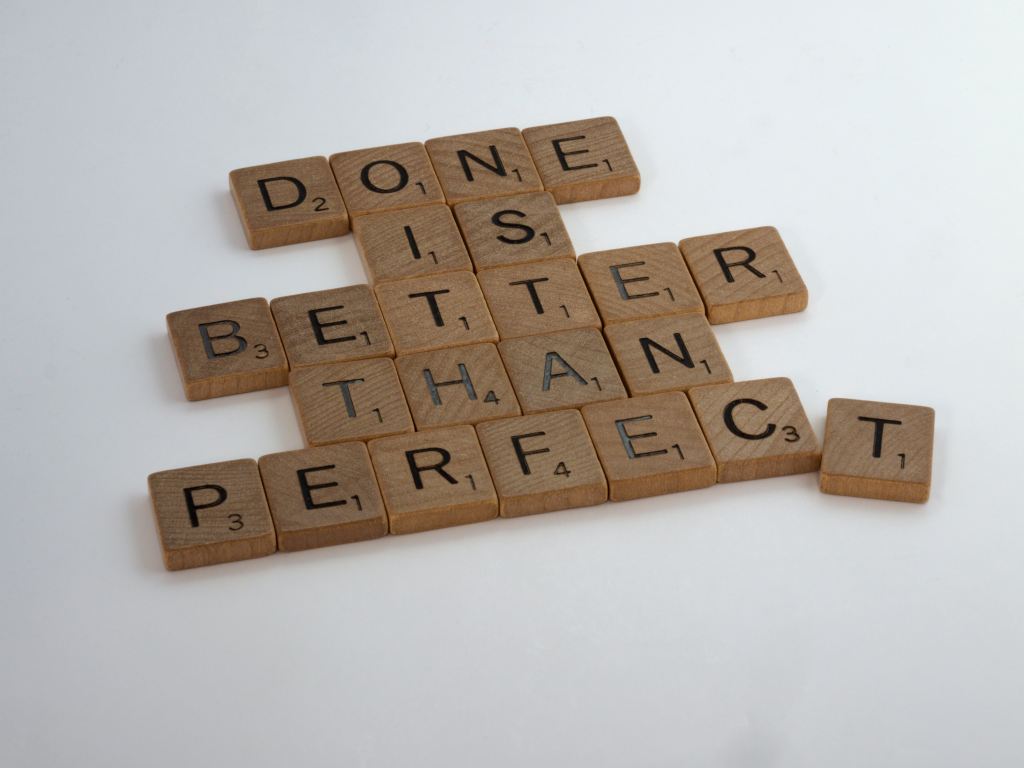
Not everything has to be perfect; it just has to be good enough. You’ll stress yourself out trying to get every detail exactly right, and most times, that won’t happen. There is always something that you will not be satisfied with, so settle for good enough and learn to be content with that. It’s also okay to only be a beginner or an amateur at something and not master it.
Start learning to enjoy the process rather than finding your satisfaction in the result; set reasonable and achievable goals to help you do this. Reward yourself with something fun after achieving a goal; keep things simple.
Don’t beat yourself up if something goes wrong or doesn’t end as you’d hoped. Take the criticism, if there is any, and use it for good. Take the feedback and learn from it how you can improve instead of viewing it as an attack. Let the negative flow over you and speak positive thoughts in their place, whether in your head or out loud. Don’t let the negativity cloud your emotions.
You will never reach perfection or be perfect, so trying is pointless. You can only be the best you can be and do the best you can do. Everyone is unique and has their limits. Be patient with yourself as you figure out your limits and how you can be the best within those.
Why can’t we reach perfection?
We can’t reach perfection because we are imperfect. It’s a simple fact of life. Since sin entered the world, there was never a chance that we could be perfect. Only Jesus was perfect, and as much as we can try to be like him, we can’t. Still, we can strive to be more like him in character and trust that God will help shape us into the person He wants us to be.
Perhaps once we pass from this world, we could reach perfection, but the only chance is if we are saved and reach Heaven. Only there will we be perfect because all impurities and sin will be destroyed, and we will be made new and have new bodies. Then I think we can say we are perfect. But with that in mind, it’s sad because most people refuse to acknowledge that God exists or turn from their sinful ways and follow Him. The point is trying to be perfect or reach perfection will do us no good. We must trust that whatever we do is good enough and that God can use our best for His good. Trying to be perfect may only lead us to sin, which is not what God wants for us. Trust in God and in the word that He has given us. By doing so, we may reach perfection in Heaven, but until then, all God wants is for us to do our best, and we must let that be good enough.
‘But he said to me, “My grace is sufficient for you, for my power is made perfect in weakness.” …That is why. for Christ’s sake, I delight in weaknesses, in insults, in hardships, in persecutions, in difficulties. For when I am weak, then I am strong.’
2 Corinthians 12: 9-10
Similar Posts
- The Power of Gentleness
- The Power of Words
- God’s Character: What it means for our lives
- Authenticity: What does the bible say about it?
- Forgiveness: What you need to know
References
- Taarini. (2015) Idolizing People and What It Means For Us. Available at: Idolizing People and What It Means For Us | by Taarini | Medium [Accessed 8 September 2023]
- Levine, S. (2017) Our Illusions of Role Models, Heroes and Idols. Available at: Our Illusions of Role Models, Heroes, and Idols | Psychology Today [Accessed 8 September 2023]
- Swider, B. et al. (2018) The Pros and Cons of Perfectionism, According to Research. Available at: The Pros and Cons of Perfectionism, According to Research (hbr.org) [Accessed 9 September 2023]
- Scott, E. (2023) Perfectionism: 10 Signs of Perfectionist Traits. Available at: Perfectionism: 10 Signs of Perfectionist Traits (verywellmind.com) [Accessed 9 September 2023]
- Horan, K. (2021) 10 Signs of a Problem with Perfectionism. Available at: 10 Signs of a Problem with Perfectionism | Psychology Today [Accessed 9 September 2023]
- Cox, J. (2022) 7 Steps to Overcome Perfectionism. Available at: 7 Ways to Cope with Perfectionism (psychcentral.com) [Accessed 11 September 2023]
- Scott, E. (2022) How to Overcome Perfectionism. Available at: How to Overcome Perfectionism (verywellmind.com) [Accessed 11 September 2023]


 Wholeheartedly Faithul
Leave a reply to Springing into Change: Embracing the season of renewal and growth – Wholeheartedly Faithful Cancel reply