
As soon as December 1st hits, so does Christmas mania if it hasn’t already. And with the coming of December comes the season of Advent known to most as the pre-Christmas time when advent calendars are opened. But there is more to this season than most people know.
What is Advent?
The word Advent comes from the Latin ‘adventus’ and means ‘coming’ or ‘arrival’. It is a season of preparation and anticipation leading up to Christmas. We prepare ourselves spiritually for Christmas and anticipate Jesus’ second coming. Advent lasts for roughly four weeks and is marked at services across the world on the four Sundays that lead up to Christmas which will this year include Christmas Eve.
The hymn ‘O Come, O Come, Emmanuel’ encapsulates the Advent season perfectly.
The History of Advent
The first Advent celebrations are noted to have begun in northern Italy around the 5th century. There Christians observed a week-long period of fasting, prayer and reflection on Christian values to prepare for Christmas.
Around this time Spain celebrated Advent as a period of 40 days of penance, prayer and fasting to prepare for new Christians to be baptised on Epiphany. Epiphany is the January feast which remembers the Magi’s visit to Jesus in Bethlehem and in some places they remember Jesus’ baptism.
By the 6th Century French Christians were fasting for five weeks to prepare for Christmas, they called it ‘St Martins Lent’.
So originally Christmas and Advent didn’t have a big connection like they do now. But by the 6th century, Roman Christians had tied Advent to the second coming of Christ. It wasn’t until the Middle Ages that Jesus’ birth was linked to Advent.
How to Celebrate Advent
Modern Advent celebrations draw on aspects from all traditions dating back to those early Advent celebrations including prayer and fasting. The heart of the Advent remains unchanged for those who celebrate it with Jesus coming being at its core regardless of whether it’s the first or the second.
Eastern Orthodox churches celebrate Advent by fasting, often called the Nativity Fast.
Most churches have Advent-themed services on the four Sundays leading up to Christmas. The first Sunday is about Hope, the second Preparation, the third Joy or Peace and the fourth Love. In these services scripture readings are with passages about Christ’s return in judgement, the expectation of the coming Messiah from the Old Testament and the announcement of Christ’s arrival in the New Testament.
Just as Christmas has its decorations and lights so does Advent.
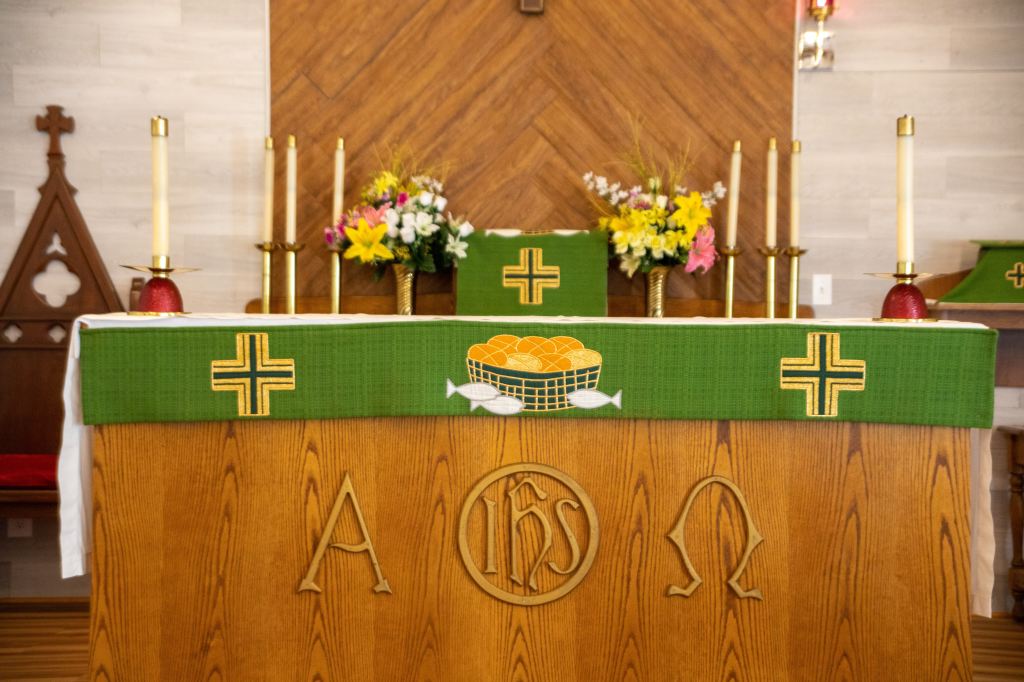
Some churches have decorations inspired by and using the Greek letters Alpha and Omega because of Revelation 1:8.
“I am the Alpha and the Omega,” says the Lord God, “the one who is, who was, and who is to come, the Almighty.”
Revelation 1:8
Many churches have Advent candles. There are four Advent candles, and one is lit each Sunday in the lead-up to Christmas. They represent hope, faith, joy, and peace. Sometimes there is a fifth candle that is lit on Christmas Day. Different denominations use different colours, some places use red candles for advent and a white one for Christmas Day or vice versa.
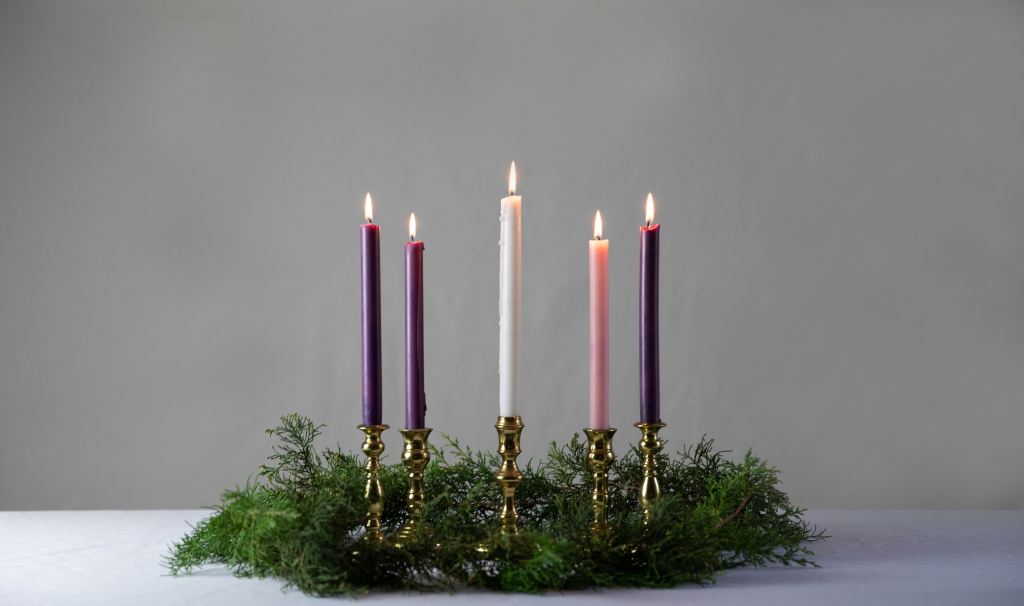
Catholic churches have a different colour theme for their Advent candles. The first Advent candle is purple and is called the Prophecy Candle. The second is also purple and called the Bethlehem Candle. The third is pink and called the Shepherd Candle. The fourth candle is also purple and is the Angel Candle. The fifth candle is white and is only lit on Christmas Eve as it is the Christ Candle. It is interesting to see how similar, yet different Advent traditions can be.
Another decoration tradition is the Advent Wreath which can have Advent candles placed in it. This tradition dates back to 1838 when a German Lutheran pastor used it to count down to Christmas. This wreath is created out of evergreens which symbolise eternal life and love. Holly and berries are often used and the red points to Jesus’ sacrifice on the cross. The pinecones represent the new life Jesus brings through his resurrection.
“On that day the root of Jesse will stand as a banner for the peoples. The nations will look to him for guidance, and his resting place will be glorious.”
Isaiah 11:10
The Jesse Tree is another Advent tradition dating back to the Middle Ages as a way of telling the story of Salvation from the beginning of creation to the arrival of Jesus the Messiah. The idea comes from Isaiah 11:10, the prophecy of the root of Jesus. It’s a family tree representing Jesus’ genealogy. The genealogy itself can be found in Matthew 1.
Advent calendars today are a source of great joy for many with the various kinds there are from chocolate to jewellery and more. This tradition dates back to the 19th century and was created by German Lutherans (whom it seems we can thank for a few of our traditions) to help children count down the days to Christmas. However back then it was merely chalk marking the doors and it evolved from there.
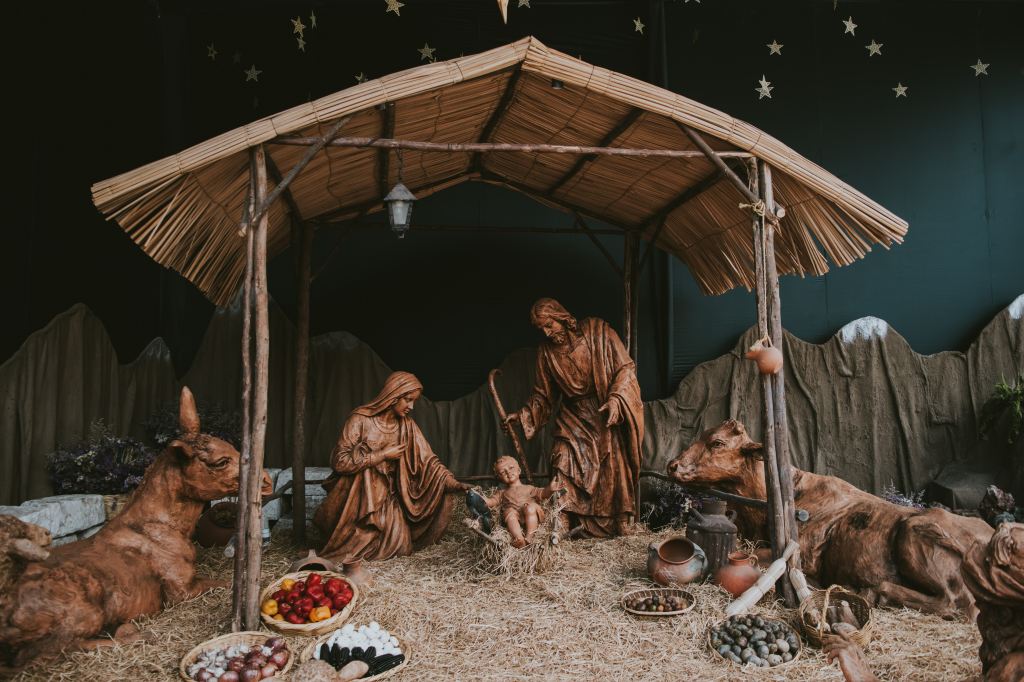
Perhaps the most well-known of all Advent and Christmas traditions is the Nativity. Nativity scenes are found in homes across the world at this time of year and plays performed by children are a seasonal spectacle everywhere though most now come with a modern twist. St Francis of Assisi is given credit for staging the first Nativity in 1223. He had received permission from the Pope to do so and he set up a manger and had a real donkey and ox to which he invited the villagers to look at while he preached about Jesus.
The Nativity may not be entirely accurate as the shepherds and wise men (or magi) do not appear together. There is also no mention of animals aside from the donkey that carried Mary. But it does make for good entertainment and a reminder of what this season is all about.
However you choose to celebrate the Advent season, I hope it is a good one. Mine will be filled with carol services and periods of quiet reflection.
Similar Posts
- Being Still in the Holidays
- Ways to Bring Jesus Back into Christmas
- Is the Nativity still important?
- Coping with Grief at Christmastime
Sources of Inspiration:
Holcomb, J. (2023) What Is Advent? The History, Meaning and Traditions. Available at: What is Advent? 2023 Guide to Meaning, History, Traditions (christianity.com) [Accessed 1 December 2023]
Fairchild, M. (2020) What is Advent? Available at: What Is Advent? Meaning, Origin, and How It’s Celebrated (learnreligions.com) [Accessed 1 December 2023]
Blakemore, E. (2021) Advent is a season of candlelight, reflection, and expectation. Available at: Advent is a season of candlelight, reflection, and expectation | National Geographic [Accessed 1 December 2023]
Nuwer, R. (2012) The First Nativity Scene Was Created in 1223. Available at: The First Nativity Scene Was Created in 1223 | Smart News| Smithsonian Magazine [Accessed 2 December 2023]


 Wholeheartedly Faithul
Leave a comment